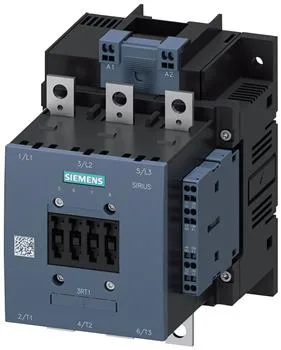
The 220-240 V AC coil is the primary fit gate — if your control voltage lands in that band, this contactor pulls in reliably. For the main power circuit, it accepts stranded cable from 25 mm² up to 120 mm², which covers the range for a 50-100 A motor branch on a 400 V system. The auxiliary contact ratings tell you what you can switch on the control side: 10 A at 24 V, 2 A at 48 V, 2 A at 60 V, and 1 A at 110 V (–,). That means a 24 VDC PLC output driving a relay or pilot light is fine; at 110 VAC the contact is limited to 1 A, so don't hang a heavy solenoid bank off it without checking the inrush. Switching rates vary by duty class: 800 cycles/hour for resistive (AC-1), 750 for motor running (AC-3/AC-3e), 300 for slip-ring motor start (AC-2), and 130 for plugging/reversing (AC-4). If your application does frequent jogging or reversing, the AC-4 limit of 130 ops/hour is the real constraint — the contactor will thermally survive that, but don't try to run it at AC-1 speeds in a reversing duty. The clearance distances — 10 mm upwards/downwards/sideways, 20 mm forwards — are the minimum air gaps to maintain around the contactor for arc flash and heat dissipation; don't cram it against the gland plate.
Dimensions are 172 mm high, 120 mm wide, 170 mm deep. That's the S6 frame envelope — allow the clearance zones above and you can fit it on a standard DIN-mounting plate or backpanel. The screw-fixing method means four M6 or M8 bolts through the mounting holes (9 mm diameter, single hole per corner,). Solid or stranded control wiring is 2x 0.25–2.5 mm², which is standard for a 1.5 mm² control cable.