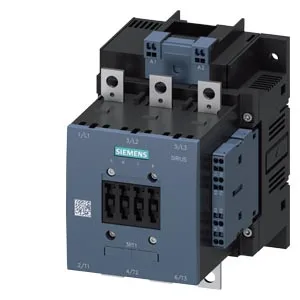
The electrical life depends on the duty class: at AC-1 (resistive loads) you get up to 800 switching cycles per hour, at AC-3 (squirrel-cage motor start/run) it's 750 per hour, and at AC-4 (plugging/inching) it drops to 130 per hour. The auxiliary switch is present, rated 10 A at 24 V, 2 A at 48 V, 2 A at 60 V, and 1 A at 110 V. These are the contact ratings for the aux block — useful for PLC inputs or interlocking, but don't try to switch a motor starter coil at the 10 A figure if the coil inrush exceeds the aux contact's make/carry rating.
Physical integration — panel space and wiring
Dimensions: 172 mm tall, 120 mm wide, 170 mm deep. That depth matters for enclosure depth — you need at least 170 mm plus clearance for the main power cables and any arc-chute venting. Main power wiring accepts stranded cable from 25 to 120 mm² — that's a serious cable range, typical for a contactor this size feeding a motor or a distribution bus. That's the minimum air gap for heat dissipation and arc containment — don't crowd it against the backplate or another device.