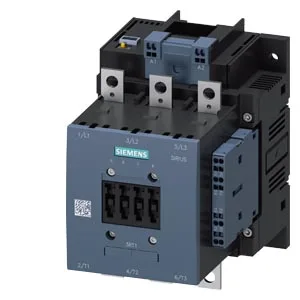
The spring-type coil terminals speed up wiring — no screwdriver needed on the coil side, which matters when you're landing dozens of contactors on a DIN-rail assembly.
The S6 frame carries a rated operational current that depends on the duty cycle. At AC-3 (squirrel-cage motor starting), the maximum switching rate is 750 operations per hour; at AC-4 (plugging/inching), it drops to 130 ops/h — the thermal load of reversing duty limits the mechanical pace. The auxiliary switch is included, rated 10 A at 24 V, 2 A at 48 V and 60 V, and 1 A at 110 V. These ratings govern the auxiliary contact's ability to break inductive pilot loads — a 24 V PLC output driving a contactor coil is well within the 10 A continuous rating, but the 110 V at 1 A figure tells you not to parallel multiple contactor coils on one auxiliary contact.
Fastening is by screw fixing, not DIN-rail snap-on — plan for a backplate or mounting rail with drilled holes. Power wiring accepts stranded conductors 25-120 mm² on the main poles; the auxiliary and coil terminals take solid or stranded 2x 0.25-2.5 mm². Minimum clearance: 10 mm upwards, downwards, and sideways, 20 mm forwards. The 170 mm depth and 172 mm height with 120 mm width mean it occupies about 0.02 m² of panel area — factor that into your gland-plate layout and wire-bending space.
The contactor's mechanical life is typical 10,000,000 operations. These figures matter for coordination with upstream short-circuit protection — the arcing time window tells you the fault-clearing device must hold off long enough for the contactor to open without welding its main contacts.