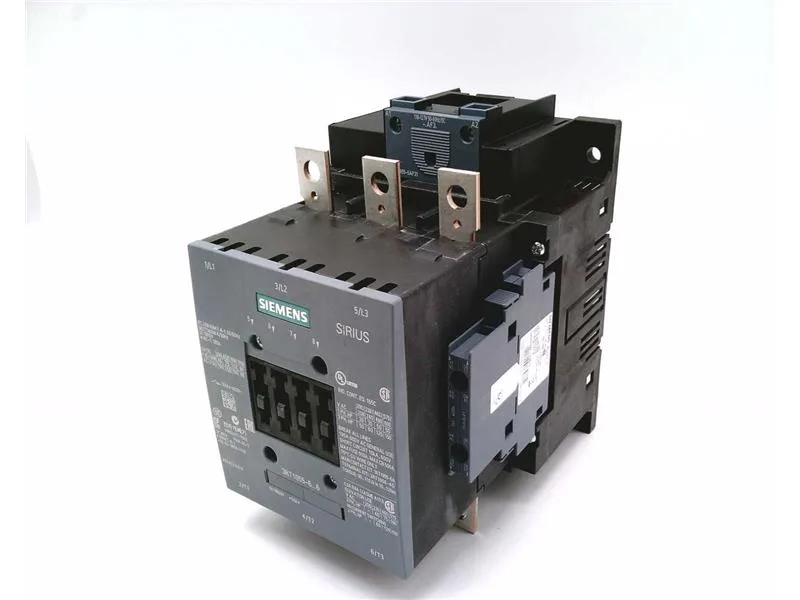
This one pulls a 110-127 V AC coil, so it's a straight swap into existing 120 V control transformers without a separate DC supply on the van. The power terminals accept stranded cable from 25 mm² up to 120 mm², which means it handles the fat feeder for a 50-75 kW motor depending on duty cycle. Mounting is screw-fix to a vertical surface, and the contactor body can be rotated ±90° or tilted ±22.5° front-to-back — useful when you're shoehorning it into a panel that wasn't laid out for this frame. Clearance requirements are modest: 10 mm upward, 20 mm forward, 10 mm to the side, 10 mm downward.
Coil and auxiliary realities
The magnet coil uses screw-type terminals — no push-in or spring-cage on this variant. That's typical for this frame size — fast enough for most motor starts, but if you're sequencing contactors in a reversing or star-delta scheme, account for the full 60 ms before the next transition.
Switching frequency and duty
Rated switching frequency varies by duty class: 800 operations per hour at AC-1 (resistive loads), 750/h at AC-3 (squirrel-cage motors, starting and disconnecting running), 300/h at AC-2 (slip-ring motors), and 130/h at AC-4 (plugging, inching, reversing). The AC-3e rating also sits at 750/h. For a conveyor or pump running a standard start/stop cycle, the AC-3 750/h limit gives you about one start every 4.8 seconds — plenty for process work.
Environmental and storage
That covers unheated warehouses and most plant-floor conditions.