What this contactor's size means for your panel layout
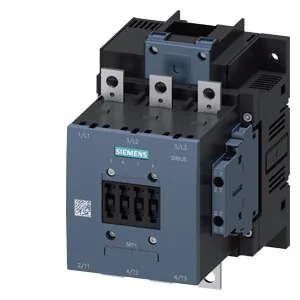
The 3RT1055-6AP36: At 172 mm tall, 120 mm wide, and 170 mm deep, this is a substantial block. You need 10 mm clearance above and below, 20 mm forward, and 10 mm to the sides for arc flash and airflow. That rules out tight sub-panels unless you plan the gland plate and busbar runs around it. Mounting is via screw fixing, not DIN rail — so factor in the drilling template and the 9 mm mounting holes.
Coil voltage and auxiliary contact ratings — what to match on the BOM
That means at 220 V it picks up reliably down to 176 V and won't drop out until well below nominal — good for lines with brownout conditions or long cable runs. That's enough for a PLC input or a holding circuit interlock, but if you need higher auxiliary current, plan an external relay block. The coil connection uses screw-type terminals, which are straightforward for panel wiring but slower to terminate than spring-cage if you're building hundreds of panels. The power side accepts stranded cable from 25 to 120 mm² — that's the range you'd expect for a contactor this size driving a 50–100 hp motor.
Switching frequency — how fast can it cycle?
The maximum switching rate depends on the duty class: 800 operations per hour in AC-1 (resistive loads), 750 in AC-3 (squirrel-cage motors), 300 in AC-2 (slip-ring motors), and 130 in AC-4 (plugging/inching). For most motor starting applications, AC-3 at 750 ops/h means it can cycle about every 5 seconds — fine for conveyor start/stop but not for high-speed indexing. That's typical for a contactor this size; don't expect fast switching like a semiconductor relay.
Temperature limits and storage — where can it live?
Electrical life depends on the switching current and duty; for AC-3 at rated current, expect hundreds of thousands of operations before the main contacts need replacement.