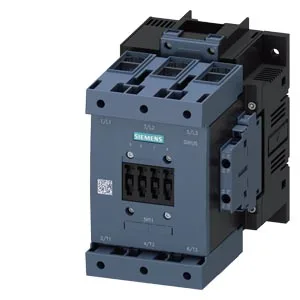
It carries an integrated auxiliary switch, so you don't need to add a separate block for basic feedback or status signaling. Mounting is screw-fix to a vertical surface — no DIN rail, so plan for panel drilling.
The coil holds at 23–26 VDC; the pickup and dropout timing is 40–60 ms for both AC and DC, so it's predictable for sequencing logic. Switching frequency varies by duty: AC-1 (resistive) max 800 ops/h, AC-3 (motor starting) max 750 ops/h, AC-4 (plugging/inching) max 130 ops/h.
Wiring and connections
Main power terminals accept stranded 16–70 mm² — that's substantial cable, sized for the S6 frame's current capacity. Control wiring (coil and aux) takes solid or stranded 0.5–4 mm², with dual-entry options for looping through. Auxiliary contact ratings are given at various voltages: 10 A at 24 V, 2 A at 48/60 V, 1 A at 110 V, 0.9 A at 125 V, 0.3 A at 220 V. That covers standard control voltages — just match the load side to the right column.