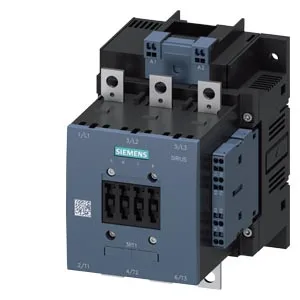
Mounting and Wiring — What the Panel Guy Needs
Mounts via screw fixing on a vertical surface; you can rotate it ±90° or tilt it ±22.5° forward/back, which gives you some flexibility in a crowded enclosure. Clearance: 10 mm up, down, and sideways; 20 mm forward for the arc chute. Main power terminals accept stranded wire from 25 to 120 mm² — that's a serious lug range, sized for the S6 frame's full rated current. The coil connection uses spring-type terminals that take 2x (0.25–2.5 mm²) solid or stranded, so you can daisy-chain the control supply without ring tongues.
Duty Cycles and Contact Life — Real-World Pacing
Switching frequency depends on the duty: AC-1 (resistive loads) lets you run 800 operations per hour; AC-3 (squirrel-cage motors, starting and running) is 750 ops/h; AC-2 (slip-ring motors) drops to 300; AC-4 (plugging, inching) is the hardest at 130 ops/h. The AC-3e rating matches the standard AC-3 at 750 ops/h, so no penalty for the 'e' classification. Arc time per break is 10–15 ms, and the power factor at 50/60 Hz is 0.8, which is what you'd expect for a motor load.
Auxiliary Contacts and Temperature Range
Built-in auxiliary switch is present, rated 10 A at 24 V, 2 A at 48 V and 60 V, and 1 A at 110 V. Those numbers matter for the control circuit design — 24 V pilot duty is the strongest leg. If your panel sits in a non-conditioned mill or yard, the -25 °C floor is fine for most climates, but the +60 °C ceiling inside a sealed cabinet near a furnace or compressor needs a derate check.