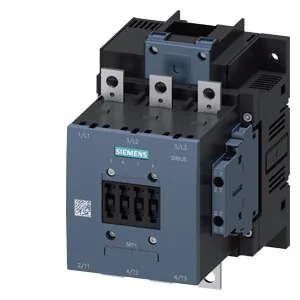
The main power lugs accept stranded cable from 25 mm² up to 120 mm². That's a heavy cable — think main feeder or large motor branch circuits, not control wiring. That's ten million cycles before the mechanical bits wear out — for a contactor running a conveyor that cycles once a minute, that's about 19 years of continuous service. The electrical life depends on your load and duty cycle, but the mechanical endurance gives you a ceiling on the frame's reliability. Switching frequency varies by duty: 800 operations per hour at AC-1 (resistive), 750 at AC-3 (motor run), and 130 at AC-4 (plugging/inching). If you're doing heavy jogging or reversing, that 130 ops/h limit is the one that governs — don't spec it for a rapid-reversing application without checking the thermal curve. Operate time is 40... 60 ms on both AC and DC, and arcing time runs 10... 15 ms. That's typical for a contactor this size — fast enough for most motor start/stop sequences, but not a high-speed transfer switch.
Environmental and Mounting Details
Dimensions are 172 mm high, 120 mm wide, and 170 mm deep. That's a big contactor — expect to leave 10 mm clearance above and below, 10 mm to the sides, and 20 mm in front for arc chute venting. Don't cram it tight against the gland plate or another device.