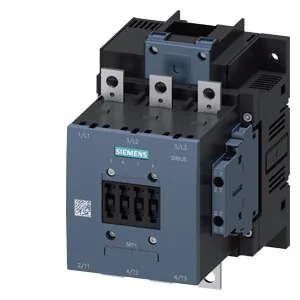
What the S6 frame and 200-220 V coil mean for your panel
The coil is rated for 200-220 V AC, so it pulls in reliably across that voltage window; the 0.8 holding factor at 50/60 Hz means it stays sealed down to about 160 V, giving you headroom against brownout dips. Clearance distances are specified: 10 mm upwards, 20 mm forwards, 10 mm sideways, 10 mm downwards. That's the air gap needed around the arc chamber for safe quenching — respect those when laying out the gland plate or adjacent components.
Switching duty and mechanical life
The contactor is rated for different switching frequencies depending on the load category: up to 800 operations per hour in AC-1 resistive duty, 750 in AC-3 motor starting, and 130 in AC-4 inching/plugging. The AC-3e rating matches the AC-3 figure at 750 ops/h. That tells you this contactor is designed for frequent motor starting — it can handle a conveyor or pump cycling every few seconds, not just a once-a-shift isolation switch. Mechanical life is typical at 10,000,000 operations. That's the no-load endurance; under load you'll get fewer, but it gives you a baseline for preventive replacement intervals in high-cycle applications like a pick-and-place cell.
Auxiliary switching and control circuit ratings
An auxiliary switch is built in. The control circuit contacts are rated for 10 A at 24 V, 2 A at 48 V and 60 V, and 1 A at 110 V. That covers typical PLC output signals or relay interposing — the 24 V rating is generous enough to drive a small contactor coil or indicator light without an extra interposer.