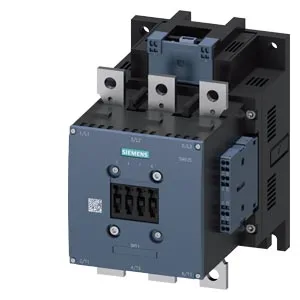
The coil pulls in at 21 VDC and holds across the 21 to 27.3 VDC range, with a 1.1x full-scale pickup multiplier ensuring positive closure even at the low end of a sagging 24 V bus.
Duty Class and Switching Rhythm
This contactor is rated for AC-3 motor starting at 500 operations per hour and AC-1 resistive loads at 750 ops/h. The AC-4 inching/jogging limit of 130 ops/h is the one that matters if your application does plug reversing or frequent short-cycle starts — exceed that and the arc chutes won't clear fast enough. Arcing time sits at 10–15 ms, with a total operate time of 80–100 ms on both AC and DC control.
Wiring and Panel Fit
Main power terminals accept 70–240 mm² stranded copper — that's substantial cable for a Size S10 frame, sized for a 200+ A motor circuit. Auxiliary and coil connections use spring-type terminals taking 2x (0.25–2.5 mm²) solid or stranded. Mounting is screw-fix through 11 mm holes; the contactor can be rotated ±90° on a vertical surface and tilted ±22.5° front-to-back, which gives flexibility in tight enclosures but the 10 mm clearance to all sides (20 mm forward) still has to be maintained for arc flash containment.
Auxiliary Contact Capacity
Built-in auxiliary switch rated 10 A at 24 V, derating to 2 A at 48/60 V and 1 A at 110 V.
Environmental Limits
The storage number governs shipping and off-season spares, not running conditions. Mechanical endurance is a typical 10 million operations — the electrical endurance will be lower and depends on the switching duty class used.