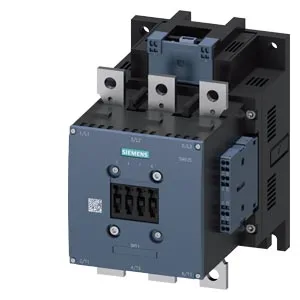
SIRIUS S10 power contactor — 3RT1064-2NP36
It mounts via screw fixing on a vertical surface, with ±90° rotatability and ±22.5° tilt front-to-back, giving flexibility in tight enclosures. The coil is rated 200-277 V AC, with spring-type terminals for the magnet coil — no screw clamping on the coil connection, so plan for a screwdriver-less termination there. Main pole power terminals accept stranded copper from 70 to 240 mm², sized for the S10 current class. Auxiliary contacts handle 10 A at 24 V, 2 A at 48 V, 2 A at 60 V, and 1 A at 110 V — enough for PLC-level signal switching or small relay loads. The auxiliary switch block is included as standard.
Duty-cycle and switching frequency
Switching frequency varies sharply by duty class: 750 ops/h in AC-1 (resistive), 500 ops/h in AC-3 (standard motor start/run), 250 ops/h in AC-2 (slip-ring motor), and 130 ops/h in AC-4 (plugging/inching). The AC-3e rating also sits at 500 ops/h. For a conveyor or pump cycling every few seconds, the AC-3 ceiling is the binding constraint — don't spec it for high-speed jogging without checking the AC-4 limit. Operate delay is 80-100 ms on both AC and DC coil supplies — consistent enough for sequential interlocking but not for fast transfer switching. Arcing time runs 10-15 ms, typical for an air-break contactor of this frame.
Thermal and mechanical endurance
The contactor includes a 1.1x full-scale overcurrent factor and an 0.8x undervoltage dropout threshold — meaning it holds in down to 80 % of rated coil voltage and can tolerate 10 % overvoltage continuously.
Dimensions are 210 mm high, 145 mm wide, 202 mm deep — the S10 frame occupies a substantial footprint. A single 11 mm diameter mounting hole is specified for screw fixing. Auxiliary terminal wiring accepts solid or stranded conductors 2x (0.25 to 2.5 mm²) — standard for control wiring. The spring-type coil terminals match the same wire range, so a single ferrule kit covers both coil and aux connections.