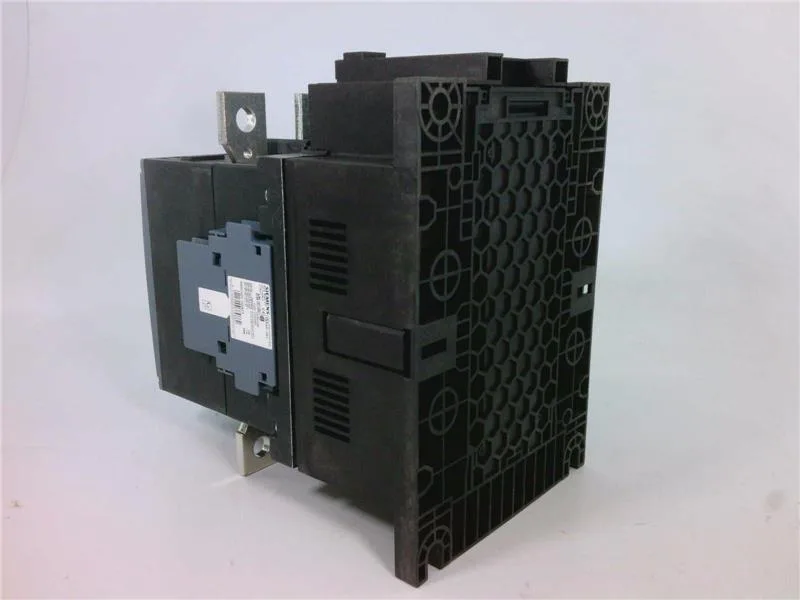
Its 110-127 V AC coil pulls in reliably down to 0.8 × rated voltage and drops out cleanly; the magnet coil uses screw-type terminals for secure wiring. The contactor carries an auxiliary switch block for feedback or interlock circuits, with DC switching ratings that matter for PLC inputs — 10 A at 24 V, 2 A at 48 V, 2 A at 60 V, 1 A at 110 V, and 0.9 A at 125 V.
Mounts via screw fixing with a single 11 mm hole. Dimensions are 210 mm high, 145 mm wide, and 202 mm deep — the depth is the key clearance number for gland-plate planning. Main power terminals accept stranded wire from 70 to 240 mm²; auxiliary terminals handle 2× (0.5 to 1.5 mm²) solid, 2× (0.75 to 2.5 mm²) stranded, or max 2× (0.75 to 4 mm²).
Switching frequency varies by duty class: up to 750 operations per hour at AC-1 (resistive), 250/h at AC-2 (slip-ring motors), 500/h at AC-3 (squirrel-cage motors), and 130/h at AC-4 (plugging/inching). The full-scale overload factor is 1.1, meaning the contactor can handle 10% above its rated continuous current for short durations — useful when sizing for motor inrush.