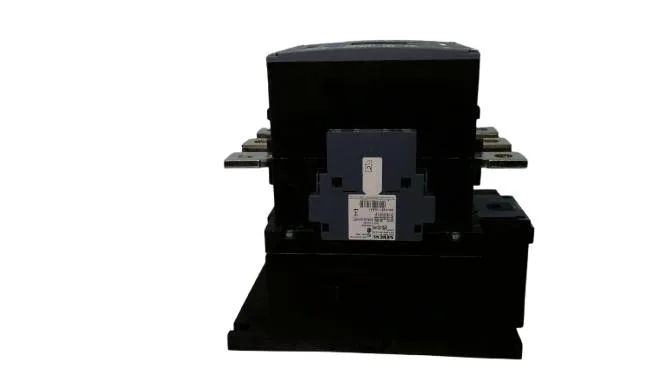
The AC-3 switching frequency of 500 operations per hour tells you this contactor is rated for continuous motor starting duty — think conveyors, pumps, compressors running multiple start-stop cycles per shift. The AC-4 rating drops to 130 ops/h, which covers inching and plugging duty where the contacts break full-load current on every transition. If your application is strictly resistive heating or lighting, the AC-1 rating of 750 ops/h gives you headroom for frequent cycling. In real AC-3 motor service, you'll get a fraction of that before the contacts need inspection, but the mechanical figure tells you the actuator won't seize up before the electrical life is exhausted. The auxiliary contact block is built in (not a bolt-on), rated at 10 A at 24 V, 2 A at 48-60 V, and 1 A at 110 V.
Mounting and wiring constraints for the panel builder
This contactor mounts via screw fixing with an 11 mm hole diameter — not a snap-on DIN rail mount. That means you need a backplate or mounting rail with pre-drilled holes, and you'll need M10 or 3/8" bolts. That's the arc-venting envelope — pack it tighter and you risk flashover between adjacent metalwork. The arcing time is 10-15 ms, so the plasma clears fast, but the clearance numbers are the minimum, not a suggestion. Power wiring accepts 70-240 mm² stranded cable on the main terminals — that's substantial, roughly 2/0 to 500 MCM in AWG terms. The coil wiring is screw-type terminals accepting 2x 0.5-1.5 mm² solid or 2x 0.75-2.5 mm² stranded, with a max of 2x 4 mm². That's standard for control wiring; no special ferrules needed.