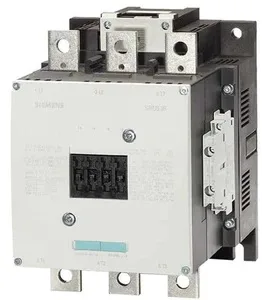
S10 frame contactor for high-current motor switching
The 3RT1064-6AP36-ZX95: It handles main power cables from 70 up to 240 mm² stranded, so it's sized for high-current feeders — think large pumps, compressors, or conveyor drives pulling several hundred amps. Coil connection is via screw-type terminals, and the auxiliary switch is built in — no separate add-on block needed for basic status feedback. The power factor at 50/60 Hz is 0.9, typical for a large AC coil.
Panel fit and mounting constraints
This contactor measures 210 mm high, 202 mm deep, and 145 mm wide. It mounts via screw fixing through a single 11 mm diameter hole — not DIN-rail snap-on, so budget panel drilling time. These are the air gaps needed around the contactor for heat dissipation and arc flash containment — don't crowd it against the backplate or other components.
Duty cycle and mechanical endurance
The contactor is rated for different switching frequencies depending on the duty class: 750 operations per hour in AC-1 (resistive), 250/h in AC-2 (slip-ring motors), 500/h in AC-3 and AC-3e (squirrel-cage motors), and 130/h in AC-4 (plugging/inching). For a typical motor start application (AC-3), you get 500 cycles per hour — that's one start every 7.2 seconds, which covers most pump and fan cycling. Mechanical endurance is 10 million operations typical — that's the contactor's life before the mechanism wears out, not the electrical contact life under load. Electrical endurance depends on the switched current and duty class; for high-current AC-4 duty you'll get far fewer cycles before contact replacement. If the panel ambient exceeds 60 °C, derating applies.
The SIRIUS family is Siemens' main industrial contactor line, so spares and replacements are widely available. No direct second-source cross-reference to the listed peer MPNs (6ES7517-3FP00-0AB0, 6AG1215-1BG40-5XB0, 6ES7214-1BG40-0XB0) — those are Siemens PLC modules, not contactors, so they won't drop in as a functional replacement.