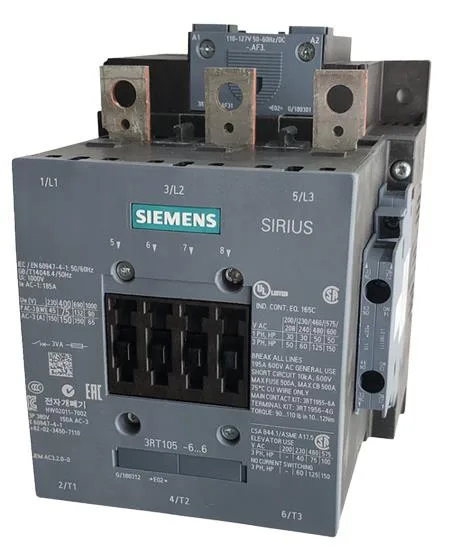
Rated coil voltage is 110... 127 V AC, with the magnet coil terminated on screw-type terminals so you can land field wiring without a special tool. The contactor carries an auxiliary switch as standard, giving you a spare N/O or N/C for status feedback to the PLC or a run light. It lives in the SIRIUS family, which means the mounting footprint, accessory rail, and bus-bar system are shared across the size S10 frame. If you've got other S10 contactors or overload relays in the panel, this one lines up on the same screw-fixing centres — no adapter plate needed.
Switching rates: AC-1 at 750 cycles/hour, AC-3 at 500 cycles/hour, AC-4 at 130 cycles/hour. Operate time is 40...80 ms on both AC and DC control. Arcing time runs 10...15 ms. The auxiliary contact ratings cover the usual control voltages: 10 A at 24 V, 2 A at 48 V or 60 V, 1 A at 110 V. That's enough to drive a small contactor or a PLC input directly, but if you're switching a heavy solenoid bank, run it through an interposing relay. That matters when you're calculating transformer sizing for the control circuit.
Mounting position is flexible: vertical surface, rotatable ±90°, and tiltable ±22.5° to front and back. That means you can orient it to match the gland-plate entry or the bus-bar run without fighting the panel layout. Fastening is screw fixing — two 11 mm holes on a standard S10 pitch. No DIN rail; it bolts direct to the backplate. That's the minimum air gap to adjacent metalwork or another device for arc containment and cooling. If you're packing contactors tight in a multi-row panel, these numbers govern the row spacing. Main power terminals accept stranded cable from 70 mm² up to 240 mm² — that's a heavy lug, typical for a feeder or a large motor circuit. The auxiliary and coil terminals take 2x (0.5... 1.5 mm²), 2x (0.75... 2.5 mm²), max. 2x (0.75... 4 mm²) solid or stranded. That covers standard control wiring with room for daisy-chaining.
Environmental and storage
Operating temperature range is -25... +60 °C — fine for a ventilated enclosure in most plant-floor conditions. Storage range extends to -55... +80 °C, which covers warehouse extremes from frozen to desert storage.