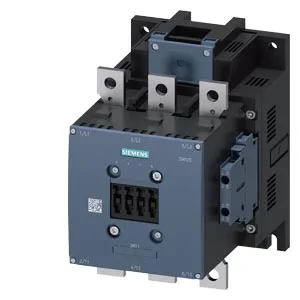
It mounts via screw fixing (four 11 mm holes on a 145 x 210 mm footprint) and accepts stranded power cables from 70 up to 240 mm² — the kind of lug-terminated feed you see on a 100+ A motor branch circuit.
Rated operational voltage is 440-480 V AC — the common 480 V industrial distribution level in North America and 440 V in some IEC markets. The contactor carries a power factor of 0.9 at both 50 and 60 Hz, which is typical for a motor load at full speed. The AC-3 switching frequency is rated at 500 operations per hour maximum; AC-4 (plugging / inching) drops to 130 ops/h. If your application is pure resistive heating (AC-1), you can run it at 750 ops/h. Coil terminals are screw-type, matching the main power termination style.
Mounting and environmental flexibility
Mounting position is unusually flexible: the contactor can be mounted on a vertical surface and rotated ±90°, or tilted ±22.5° forward and back. That helps when you are fitting it into a tight corner of a panel or on a swing frame.