Duty-cycle reality — the switching frequency that matters
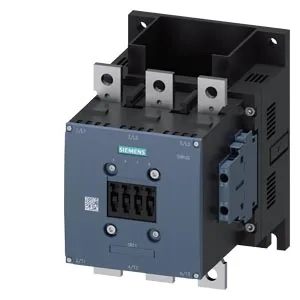
The 3RT1064-6LA06: This contactor is rated for 500 switching cycles per hour at AC-3 (motor starting) and AC-3e. At AC-1 (resistive loads) it can do 750 ops/h; at AC-2 (slip-ring motors) it drops to 250; at AC-4 (plugging/inching) it's 130 ops/h. The arcing time sits at 10–15 ms, with opening times of 40–80 ms on both AC and DC coils. For a maintenance tech or controls integrator: if your application cycles a motor more than once every 7 seconds at AC-3, this contactor will overheat the arc chamber — step up to a larger frame or reduce the duty.
Mounting and environment — panel integration notes
That's useful when you're squeezing it into a tight enclosure corner. If this lives in a non-conditioned cabinet near a furnace line or outdoor substation, the -25 °C floor is fine for most climates — but the +60 °C operating ceiling means you need to check internal cabinet temperature rise if it's mounted near other heat sources.
Auxiliary contact ratings across the voltage range
Its rated current varies by voltage: 10 A at 24 V, 2 A at 48 V and 60 V, 1 A at 110 V, 0.9 A at 125 V, 0.3 A at 220 V, 6 A at 230 V, 3 A at 400 V, and 1.4 A at 440 V. That's typical for a contactor auxiliary block — the current drops as voltage climbs, limited by arc extinction capability. For a panel builder wiring a 24 VDC PLC input through the aux, the 10 A rating gives plenty of headroom; at 230 VAC control circuits, the 6 A rating still covers most pilot-duty loads.