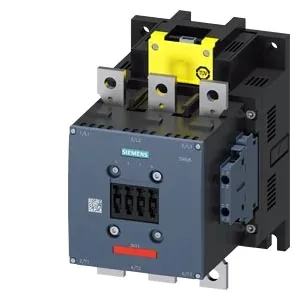
The coil pulls in at 200-277 V AC and holds across that range — useful for panels where line voltage can sag without dropping the contactor out. Screw-type coil terminals and a screw-fixing base mean it lands on a mounting plate or DIN rail adapter with standard tools, no special hardware.
The contactor is rated for AC-1 (resistive) loads at up to 500 switching cycles per hour, AC-3 (squirrel-cage motor start/run) also at 500 cycles per hour, and AC-4 (plugging/inching) at 130 cycles per hour. The arcing time sits at 10-15 ms, which is typical for a contactor this size and means the arc chute clears fast enough to keep contact erosion predictable. Auxiliary contacts are built in, rated 10 A at 24 V, 2 A at 48 V, and 2 A at 60 V — enough for pilot-duty signaling to a PLC input or a control relay. The main power circuit accepts stranded conductors from 70 to 240 mm², so it ties into heavy motor feeders without needing a separate terminal adapter. Auxiliary terminals take 0.5-4 mm² stranded or solid, which covers most control wiring. Mechanical endurance is listed at 10 million operations typical. That's a design-life figure, not a guaranteed minimum, but it puts this contactor in the long-service category for a Size S10 frame — you'd expect it to outlast several motor rewinds in a standard conveyor or pump application.
The contactor measures 145 mm wide, 210 mm high, and 202 mm deep.
Operating environment
That storage range covers most warehouse and shipping extremes without special handling. The operating range is standard for a panel-mounted contactor — no derating needed at typical 40 °C enclosure ambient, but if the panel runs hot (above 60 °C) you'd need to check the thermal curve.