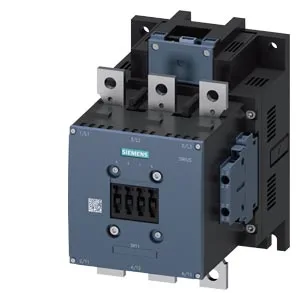
It carries a 110 V DC coil and includes an integrated auxiliary switch. Screw fixing and the 202 mm depth mean it mounts on a flat panel or DIN rail adapter plate — not a direct snap-on DIN rail mount, so plan for screw terminals and the gland plate clearance. The 145 mm width and 210 mm height fit a standard contactor footprint in the S10 frame class.
The DC coil operates at 110 V rated value, with a dropout delay of 80 to 100 ms — that matters if you're coordinating with a safety relay or PLC output that needs to sequence off-delays. The auxiliary switch is rated 6 A at 24 V, 2 A at 48 V, 2 A at 60 V, 1 A at 110 V, and 0.9 A at 125 V, all DC. Use those figures to size your control-circuit fusing or electronic load; the switch is a standard form-C (changeover) contact, not a solid-state output. Mechanical life is typical 10,000,000 operations.
Switching frequency by duty class
Maximum switching rates: AC-1 (resistive) 700 ops/h, AC-2 (slip-ring motor) 250 ops/h, AC-3 (squirrel-cage motor) 500 ops/h, AC-4 (plugging/inching) 130 ops/h, AC-3e (enhanced AC-3) 500 ops/h. DC ratings: DC-1 350 ops/h, DC-3 and DC-5 both 250 ops/h. These numbers govern thermal load on the contact tips — don't exceed the AC-4 rate if you're reversing a conveyor several times a minute.
Wire termination and mounting
Terminals accept solid or stranded wire: 2x (0.5 to 1.5 mm²), 2x (0.75 to 2.5 mm²), max 2x (0.75 to 4 mm²). One mounting hole, 11 mm diameter. Screw fixing only — no spring-cage option on this variant. The S10 frame is a common size across the SIRIUS family, so panel cutouts and busbar kits for the 3RT1 series are compatible.