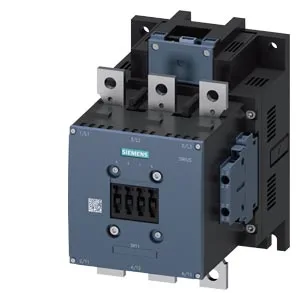
The S10 frame size tells you it's a larger contactor in the range, sized for higher current applications.
The DC coil is rated at 72 V with a pickup ratio of 0.7 x the rated value and a dropout ratio of 1.25 x the full-scale value, meaning it reliably pulls in at about 50 V and drops out around 90 V. That's a wide hysteresis, so it's forgiving on a fluctuating DC bus but won't chatter on a slow ramp-down. Switching times are 80 to 100 ms for DC and arcing time sits between 10 and 15 ms — fast enough for most motor control but not for precision timing circuits. Switching frequency varies by duty: 700 operations per hour at AC-1 (resistive loads), 500 at AC-3 (standard motor starting), 250 at AC-2, and 130 at AC-4 (plugging/inching). For DC loads, it's 350 ops/h at DC-1, 250 at DC-3 and DC-5. The AC-3e rating matches the standard AC-3 at 500 ops/h. These numbers matter when you're cycling a conveyor or a pump frequently — push past them and the contactor overheats, shortening its life. Auxiliary contacts are included, rated for DC switching: 6 A at 24 V, 2 A at 48 V and 60 V, 1 A at 110 V, and 0.9 A at 125 V. That covers most pilot-duty and PLC input circuits you'll find on the route.
Mounting is by screw fixing with a single 11 mm hole — no DIN rail on this one, so plan for a dedicated bolt-down footprint. The contactor measures 210 mm high, 145 mm wide, and 202 mm deep. That's a substantial chunk of panel space; check your gland plate and backplate layout before committing. That helps when you're shoehorning it into a crowded enclosure. Terminals accept solid or stranded wire: 2x 0.5 to 1.5 mm², 2x 0.75 to 2.5 mm², and max 2x 0.75 to 4 mm². That covers most control wiring you'll pull, but if you're landing larger power conductors, check the lug compatibility.