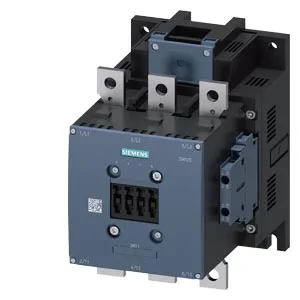
It accepts stranded conductors from 70 up to 240 mm², so it's sized for the main power path of a large motor or a distribution feeder — not a control-circuit aux contactor.
The AC-3 switching rate is 500 operations per hour. The AC-4 rate is 130 ops/h for plugging or inching duty. Power factor is 0.9 at both 50 and 60 Hz, which is typical for a contactor coil — no surprise there. That's fast enough for most motor circuits but not for semiconductor switching; if you need zero-cross or sub-cycle break, you're in the wrong class. Auxiliary contact ratings: 10 A at 24 V, 2 A at 48 V or 60 V, 1 A at 110 V. That's the dry-circuit rating for the aux block — don't expect it to switch a motor starter on its own at 110 V without derating.
Fastening is screw fixing, not DIN-rail snap-on. That gives flexibility for odd panel layouts — you can rotate the contactor to fit cable entry without a custom bracket. Dimensions: 210 mm high, 145 mm wide, 202 mm deep. That's a substantial footprint — plan for a 202 mm depth clearance behind the panel door, plus 20 mm forward and 10 mm sideways for arc clearance and ventilation. Main power terminals accept 70–240 mm² stranded. The auxiliary terminals are screw-type and accept 2x (0.5–1.5 mm²) solid or 2x (0.75–2.5 mm²) stranded, max 2x 4 mm². That's fine for control wiring but don't try to land the main cable on the aux block.