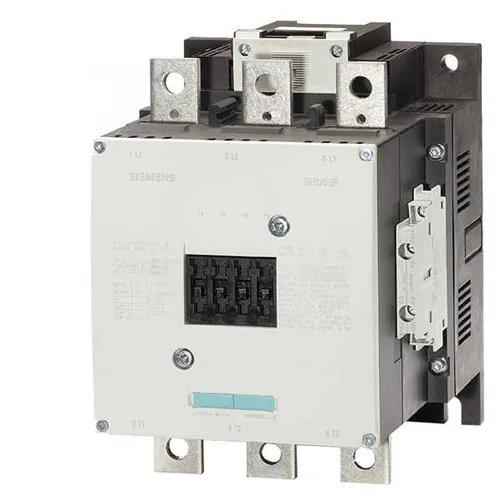
The coil is rated for 110-127 V and uses screw-type terminals. An auxiliary switch is integrated, providing a spare N/O or N/C contact for status feedback or interlocking without an add-on block.
Duty Ratings and Switching Frequency
Switching frequency varies by duty class: AC-1 (resistive) allows up to 800 operations per hour, AC-3 (squirrel-cage motor starting) permits 700 operations per hour, and AC-4 (plugging/inching) is limited to 130 operations per hour. The AC-3e rating matches the AC-3 figure at 700 operations per hour. For applications requiring frequent jogging or reversing, the AC-4 ceiling is the binding constraint — exceeding it accelerates contact wear beyond the rated mechanical life of 10 million operations.
Coil Operating Parameters and Timing
The magnet coil picks up at 0.8 times the rated voltage and the full-scale pickup factor is 1.1, meaning the coil will reliably close at 88 V and must not see sustained overvoltage above 140 V on a 127 V nominal supply. Arcing time is 10-15 ms, which is typical for a contactor of this frame size and influences the minimum off-time in reversing or inching circuits.
Mounting is by screw fixing through one 11 mm diameter hole. These clearances must be maintained for arc flash containment and heat dissipation. The overall dimensions are 210 mm height, 145 mm width, and 202 mm depth.
Power Circuit and Auxiliary Contact Wiring
The main power circuit accepts stranded conductors from 70 to 240 mm². The auxiliary circuit (coil and auxiliary switch) accepts solid conductors: 2x (0.5-1.5 mm²) and 2x (0.75-2.5 mm²), with a maximum of 2x (0.75-4 mm²). The auxiliary switch is rated at 10 A at 24 V, 2 A at 48 V, 2 A at 60 V, and 1 A at 110 V. For audit purposes, these ratings are per the specification and must be observed when sizing control transformers or fusing the auxiliary circuit.