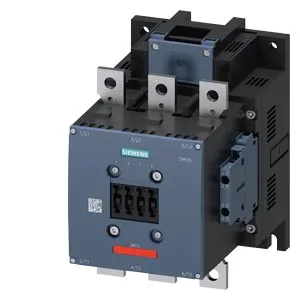
It's part of the SIRIUS family, the modular contactor range for motor switching and general load management in industrial control panels. The S10 frame is the largest standard size in the SIRIUS 3RT series, designed for high-current motor loads and heavy-duty switching applications. The main circuit accepts stranded conductors from 70 to 240 mm², which covers the cable range for motors in the 75-200 kW class on 400 V three-phase systems.
Mounting and integration constraints
Mounting is by screw fixing, not DIN rail — the S10 frame is too heavy for a snap-on foot. The contactor occupies 210 mm height, 145 mm width, and 202 mm depth, so plan for a backplate or sub-panel with clearance. The mounting position allows rotation ±90° on a vertical surface and tilting ±22.5° forward or back, which gives flexibility in tight enclosures. These are minimum air gaps for arc flash and heat dissipation — respect them in the panel layout.
Switching frequency and duty class — what the ratings mean
The contactor's switching frequency depends on the duty class. At AC-1 (resistive loads) it manages 800 operations per hour; at AC-3 (standard motor starting) it's 500 per hour; at AC-4 (plugging/inching) it drops to 130 per hour. The AC-3e rating matches the AC-3 figure at 500 per hour. These limits govern thermal rise in the arc chamber — exceeding them accelerates contact wear. If your cycle requires faster jogging or reversing, the AC-4 limit of 130 ops/hour (one every 27.7 seconds) is the binding constraint.
Operating conditions and auxiliaries
The coil holds at 220-240 V AC nominal; the pickup dropout ratio is 0.8 of rated voltage for initial pull-in and 1.1 for the full-scale holding voltage. An auxiliary switch is built in, which saves an add-on block for basic status feedback. Auxiliary contact ratings at 24 V are 10 A, dropping to 2 A at 48 V and 60 V, and 1 A at 110 V — standard de-rating for DC inductive loads.