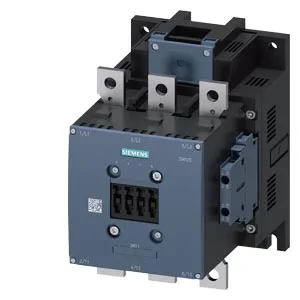
The screw-type magnet coil terminals accept solid or stranded wire — 2x (0.5 to 1.5 mm²), 2x (0.75 to 2.5 mm²), or up to 2x (0.75 to 4 mm²) — and the main power circuit handles stranded conductors from 70 to 240 mm². That cross-section range tells you this contactor is sized for heavy feeders, not small branch circuits. Coil pickup is guaranteed at 80% of rated voltage (380 to 420 V AC), dropout at 110% of rated value — so it holds in during sags but releases on overvoltage. That's typical for a frame this size; the contactor isn't fast enough for semiconductor switching but it's fine for motor starting and isolating. Electrical life depends on duty: at AC-1 (resistive) you get up to 800 operations per hour, at AC-3 (squirrel-cage motor start/run) 500 ops/h, at AC-4 (plugging/inching) 130 ops/h.
Fastening is by screw fixing through an 11 mm hole. These are the numbers to check against your panel layout — especially the 20 mm forward clearance, which is the tightest constraint for door-mounted or cover-mounted enclosures. Overall dimensions: 210 mm high, 145 mm wide, 202 mm deep. That depth includes the coil terminals; if you're replacing an existing contactor in a crowded panel, measure the available depth first.
Auxiliary switch and environmental limits
The contactor comes with an auxiliary switch fitted. Its rated current is 10 A at 24 V, 2 A at 48 V and 60 V, and 1 A at 110 V — all AC. That's enough for a feedback signal to a PLC or a status light, but if you need more aux contacts, plan on adding a side-mount block. The power factor at rated load is 0.9 at both 50 and 60 Hz.
That said, always confirm availability at quote time through independent distribution channels.