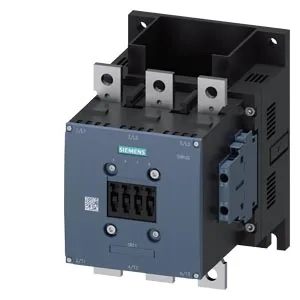
It carries an auxiliary switch built in — no separate add-on needed for basic feedback or status signaling. The coil termination is screw-type, so you land your control wires with a standard terminal screwdriver, no special crimp tool required. The actual electrical endurance depends on the switching category (AC-1, AC-3, AC-4) and the current being switched.
Mounting and wiring — what fits in the panel
Footprint is 210 mm tall, 145 mm wide, 202 mm deep. That's a substantial block — size S10 frames are for higher-current circuits, so plan the gland plate and DIN-rail layout accordingly. That's the minimum air gap to adjacent metalwork or other devices for arc containment and cooling. Power circuit wiring takes stranded cable from 70 mm² up to 240 mm² — serious cable, sized for the full current rating of this frame. The auxiliary/control circuit accepts solid or stranded wire: 2 x (0.5 to 1.5 mm²), 2 x (0.75 to 2.5 mm²), or max 2 x (0.75 to 4 mm²). That covers standard control wiring from signal-level up to modest pilot-duty runs.
The contactor is rated for different maximum switching rates depending on the load category: 800 operations per hour in AC-1 (resistive loads), 500 per hour in AC-3 (standard motor starting/running), and 130 per hour in AC-4 (plugging, inching, reversing). These numbers govern the thermal load on the arc chutes and contacts — exceed them and you'll shorten contact life fast. That's fast enough for most motor control sequences but not a high-speed DC switching application — if you're breaking DC loads, check the rated breaking currents at your system voltage (e.g., 10 A at 24 V, 2 A at 48 V, 0.3 A at 220 V).