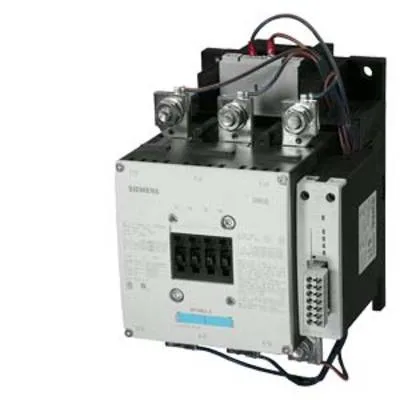
It carries a 96-127 V AC coil with screw-type terminals, and the main power circuit accepts stranded conductors from 70 up to 240 mm² — sized for the larger cable runs you see on pump, fan, and conveyor drives in a mill or plant.
Switching duty and mechanical endurance
Maximum switching rates are specified per duty class: 800 operations per hour at AC-1 (resistive), 500 at AC-3 (standard motor starting), and 130 at AC-4 (plugging/inching). The AC-3e rating also holds at 500 ops/h. Arcing time sits at 10-15 ms, and the make/break times for both AC and DC coils are 80-100 ms. The auxiliary switch is included, rated at 10 A at 24 V, 2 A at 48 V and 60 V, and 1 A at 110 V — enough for signaling back to a PLC input or a pilot light on the panel door.
Fastened by screw fixing through a single 11 mm hole. The contactor dimensions are 145 mm wide, 210 mm high, and 202 mm deep — that depth matters when you're laying out a gland plate or checking the door clearance on a 600 mm deep enclosure. Clearance distances: 10 mm upwards, 20 mm forwards, 10 mm sideways, 10 mm downwards. The coil connection uses screw-type terminals accepting solid or stranded wire: 2x (0.5-1.5 mm²), 2x (0.75-2.5 mm²), or max 2x (0.75-4 mm²). Strip length and ferrule sizing follow standard practice for this terminal family.