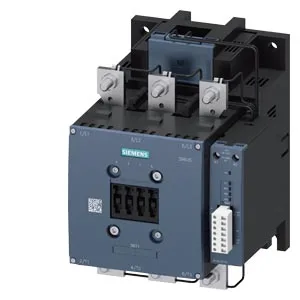
It carries a 96-127 V AC/DC coil, screw-type coil terminals, and an integrated auxiliary switch. The main power circuit accepts stranded cable from 70 up to 240 mm² — that's the class of cable you'd run for a 200 A+ motor feeder or a large resistive heater bank. The auxiliary control wiring is separate: solid or stranded 0.5-1.5 mm² for the coil loop, and up to 4 mm² for the auxiliary contacts. Mounting is screw-fixing to a vertical panel surface, with the contactor rotatable ±90° and tiltable ±22.5° front-to-back. The overall envelope is 210 mm high, 165 mm wide, 202 mm deep — plan your gland plate and enclosure depth accordingly.
Switching Performance and Duty Ratings
This contactor is rated for different switching frequencies depending on the utilization category. In AC-3 duty (squirrel-cage motor starting), it handles up to 500 operations per hour. For AC-4 duty (plugging / inching of motors), the rate drops to 130 ops/h. AC-1 (resistive loads) allows 800 ops/h, and AC-2 (slip-ring motors) is rated at 250 ops/h. The arcing time is 10-15 ms, and the closing time (both AC and DC) is 80-100 ms. Mechanical endurance is typical at 10,000,000 operations. The auxiliary contact ratings: 10 A at 24 V, 2 A at 48 V, 2 A at 60 V, 1 A at 110 V — all resistive. The coil pickup threshold is 0.8 x rated voltage, and the dropout level is 0.4 x rated voltage at both 50 and 60 Hz.