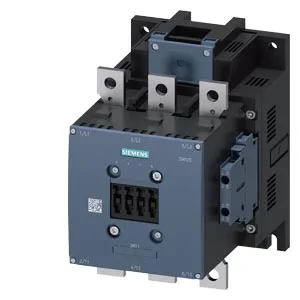
That 300 A figure tells you its thermal continuous current — the real-world limit for resistive loads in AC-1 duty. For motor switching (AC-3), you'd derate to the motor's full-load amps, but the contactor's own rating gives you headroom for high-inrush loads like compressor starts. Coil is 96-127 V AC/DC, screw-type terminals, with a pick-up dropout around 0.8 x rated voltage.
Mounts via screw fixing, not DIN rail — plan for a drilled backplate. Dimensions are 210 mm high, 165 mm wide, 202 mm deep. That 202 mm depth is the body only; you need 10 mm clearance above, 10 mm below, 20 mm in front, and 10 mm at the sides for arc flash and cooling. Mounting surface vertical, rotatable ±90°, tiltable ±22.5° front/back.
Wiring and terminations
Main power circuit takes stranded 70-240 mm² — that's a big cable, typically 2/0 to 500 MCM. Auxiliary contacts handle 2x (0.5-1.5 mm²), 2x (0.75-2.5 mm²), max 2x (0.75-4 mm²) solid or stranded. Coil terminals are screw-type, same as the main terminals.
Switching performance and life
Switching frequency varies by duty: 800 cycles/hour in AC-1 (resistive), 700 in AC-3 (motor start/run), 300 in AC-2 (slip-ring motor), 130 in AC-4 (plugging/inching). Temperature range -25 to +55 °C operating, -55 to +80 °C storage.