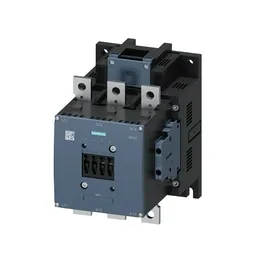
The 3RT1066-2AF36: The S10 frame measures 210 mm high by 145 mm wide by 202 mm deep — that depth is a real constraint in shallow enclosures; plan for at least 20 mm forward clearance for arc chamber ventilation and wiring bends. Mounting is by screw fixing through two 11 mm diameter holes, with the contactor rotatable ±90° on a vertical surface and tiltable ±22.5° front-to-back, so it adapts to tight gland-plate layouts without custom brackets. Minimum air gaps around the body: 10 mm above, 10 mm below, and 10 mm to the side. That's tighter than many S10-class contactors — if you're shoehorning this alongside other devices, measure the free space, not just the footprint. Coil termination uses spring-type terminals accepting 2x (0.25 to 2.5 mm²) solid or stranded wire — no screw torque to verify, but verify the ferrule strip length matches the cage depth. The pickup threshold is 0.8 x rated voltage (88 V minimum at the 110 V end), and the coil holds at 1.1 x rated value; dropout below that 0.8 threshold is typical for AC-operated contactors.
Switching capacity and duty-cycle limits
The contactor's maximum switching rates define its real-world application: 750 operations per hour in AC-1 (resistive loads), 500/h in AC-3 (standard squirrel-cage motors), and 130/h in AC-4 (plugging/inching duty). These are standard for an S10 frame — no surprises for selectivity coordination with upstream breakers, but the arcing time matters if you're sizing suppression networks across the coil.
Auxiliary contact ratings and thermal limits
The contactor ships with an auxiliary switch block. Its rated breaking capacities: 10 A at 24 V, 2 A at 48 V, 2 A at 60 V, and 1 A at 110 V — these are the DC resistive ratings for the aux contacts; inductive loads need derating. Power factor correction is rated at 0.9 for both 50 Hz and 60 Hz supplies — the contactor's coil draw is consistent across line frequencies, so no re-rating needed if the site runs 60 Hz.