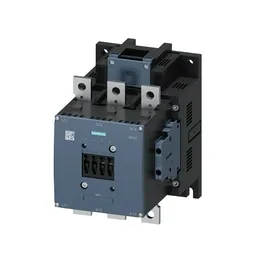
The coil is rated 500-550 VAC, and the main power circuit accepts stranded copper from 70 up to 240 mm² — that's a heavy lug range for a contactor this size, typically used on larger motor feeds or distribution. Mounting is screw fixing (four 11 mm holes on a 210 x 145 mm footprint), with a depth of 202 mm including arc chambers.
Switching duty and mechanical life
Rated switching frequencies vary by duty: AC-1 (resistive) allows up to 750 operations per hour, AC-3 (motor starting) 500 ops/h, AC-4 (plugging/inching) 130 ops/h. The AC-3e rating also sits at 500 ops/h. Mechanical life is typical at 10 million operations — that's the contactor body, not the contacts, but it gives a sense of the frame's endurance. Arcing time is 10-15 ms, and the make/break times (both AC and DC coil) are 40-80 ms. The auxiliary switch is included and rated 10 A at 24 V, 2 A at 48 V, 2 A at 60 V, and 1 A at 110 V.
Environmental and installation
The coil terminals are spring-type (accepts 2x 0.25-2.5 mm² solid or stranded), while the main power lugs are clearly for bolted connections on 70-240 mm² cable. Clearances: 10 mm upwards, downwards, and to the side; 20 mm forwards. That's tight enough for most enclosures — just watch the arc-chamber clearance forwards if you're stacking contactors side by side.