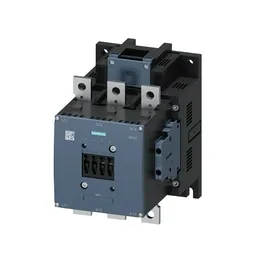
It uses screw fixing to a vertical mounting surface and allows ±90° rotation plus ±22.5° forward/back tilt, giving panel builders flexibility in tight enclosures. Dimensions are 210 mm high, 145 mm wide, and 202 mm deep. The coil terminals are spring-type (cage clamp), accepting 2x (0.25 … 2.5 mm²) solid or stranded wire. Main power terminals accept stranded cable from 70 mm² up to 240 mm² — this is a contactor you land with heavy lugs, not finger-safe ferrules.
Duty ratings and switching frequency — what the numbers mean
The contactor carries separate maximum switching rates per duty class: 750 operations/hour in AC-1 (resistive loads), 250/h in AC-2 (slip-ring motor starting), 500/h in AC-3 (squirrel-cage motor starting/running), and 130/h in AC-4 (plugging, inching, reversing). The AC-3e rating also sits at 500/h. For a motor starter application, the AC-3 rate is the one that governs — 500 ops/h means roughly one start every 7 seconds, which covers most conveyor and pump cycles comfortably. The AC-4 rate of 130/h tells you this contactor is not optimised for frequent reversing; if your application needs heavy jogging, expect to derate or step to a larger frame. Electrical life depends on the load and switching frequency; the AC-3 electrical life curve (not listed here) will be shorter. That is a standard response for a contactor this size — not fast enough for a safety circuit that needs <20 ms, but fine for normal motor starting.
Coil, auxiliary contacts, and clearances
The coil is rated 575…600 V AC — a non-standard voltage in many regions, so verify your control supply matches before wiring. An auxiliary switch is built in (the 2AT36 variant includes it), with contact ratings of 10 A at 24 V, 2 A at 48 V and 60 V, and 1 A at 110 V. That is enough for PLC inputs or indicator lamps but not for driving another contactor coil directly above 24 V. In a crowded panel, those numbers drive the fill factor — you cannot butt-mount these against the enclosure wall or another device without derating or risking arc flash between phases.
Lifecycle status is current production. This is not a phase-out or NRND line — the 3RT1066 frame remains a standard catalogue item from Siemens.