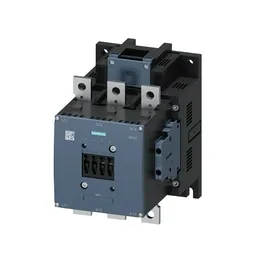
Screw fixing mounts it to a backplate or DIN-rail adapter plate; the 210 mm height, 145 mm width, and 202 mm depth mean you need to budget panel depth for the arc chamber and main pole connections, especially with the 70 to 240 mm² stranded cable it accepts on the line and load side.
Switching duty and what the numbers mean
The contactor is rated for AC-3 maximum 500 switching operations per hour — that's the motor-starting duty cycle (inductive load, full voltage). AC-4 (plugging/inching) drops to 130 ops/h; AC-1 (resistive) reaches 750 ops/h. The AC-3e rating also sits at 500 ops/h, matching the standard AC-3 figure. Arcing time runs 10 to 15 ms, with total make/break times of 40 to 80 ms on both AC and DC coils. That's a standard industrial contactor response — fast enough for most motor starts, not intended for high-speed synchronous transfer. Coil terminals are screw-type, rated for 2x 0.5 to 1.5 mm² solid or 2x 0.75 to 2.5 mm² stranded, max 2x 4 mm². Auxiliary switch is present on this variant, which saves ordering a separate side-mount block for basic status feedback.
For BOM freeze or long-term planning, the SIRIUS Size S10 platform is stable; the contactor shares its footprint and mounting with other S10 variants, so a future coil-voltage or auxiliary-contact change won't force a panel re-layout.
Main power cables: stranded 70 to 240 mm² — that's a substantial lug, typical for motor circuits above 100 A. The single 11 mm mounting hole per pole suggests bolted bus-bar or cable-lug connections, not spring terminals. These are the minimum free-air gaps for arc quenching and heat dissipation; tighter spacing forces derating of the switching frequency. The 60 °C ceiling is standard for panel-mounted contactors — derate the AC-3 switching frequency above 40 °C per the thermal curve.