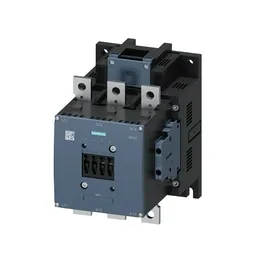
Power contactor, size S10, 575–600 V coil
The coil is screw-type terminals, which means field wiring is straightforward with ring or fork lugs — no special crimp tool needed for the control circuit. The contactor accepts solid or stranded conductors on the auxiliary side: 2x (0.5…1.5 mm²) or 2x (0.75…2.5 mm²), max 2x (0.75…4 mm²). The main power circuit uses stranded cable from 70 to 240 mm² — sized for the high-current path.
The contactor is rated for multiple duty classes: AC-1 at 750 operations/hour, AC-2 at 250/h, AC-3 at 500/h, AC-3e at 500/h, and AC-4 at 130/h (–,). The AC-3 and AC-3e rates are what matter for standard squirrel-cage motor starting — 500 cycles per hour is typical for a machine-tool or conveyor duty. AC-4 at 130/h covers plugging and inching, where the contactor opens under full locked-rotor current; the lower rate reflects the heavier arc stress. The auxiliary switch is included — that means the contactor ships with at least one built-in auxiliary contact block, so you do not need to order a separate add-on for feedback or interlocking in basic applications. Mechanical endurance is typical at 10 million operations — this is the no-load life; electrical life will be lower and depends on the switched current and duty class. The contactor is fastened by screw fixing with a single 11 mm hole — standard M10 bolt mounting, no special bracket needed.
Clearance and wiring space
The 20 mm forward clearance is the one that catches people — it is the space needed in front of the contactor for arc-chamber venting and wiring access. The 10 mm side and vertical clearances are standard for heat dissipation.