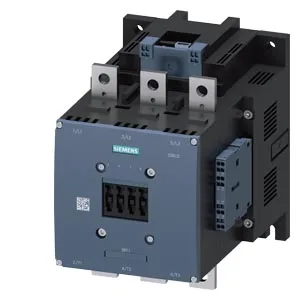
It carries a 96-127 V AC/DC rated coil and is built for screw-fixing to a mounting plate or panel — not DIN-rail snap-on, so plan for dedicated drilling and clearance. The coil draws its rated voltage across the 96-127 V range, with a pick-up dropout ratio of 0.8 (initial value) and a full-scale factor of 1.1 — meaning the coil reliably holds in at 110% of rated voltage and drops out at 80% of rated value.
Mounting and integration constraints
Fastening is via screw fixing through a single 11 mm hole. The contactor footprint is 160 mm wide, 214 mm high, and 225 mm deep — substantial for a size S12 frame, so verify panel depth before layout. Main power terminals accept stranded conductors from 70 to 240 mm² — rated for heavy motor feeders. Auxiliary switch terminals share the same spring-clamp range.
Maximum switching frequency varies by duty class: 700 operations/hour for AC-1 (resistive), 200 for AC-2 (slip-ring motors), 500 for AC-3 and AC-3e (squirrel-cage motors — the common industrial case), and 130 for AC-4 (plugging/inching). For a furnace application with frequent reversing, that AC-4 ceiling of 130 ops/hour is the binding limit. Auxiliary contacts are present (one built-in switch). Rated at 10 A at 24 V, 2 A at 48 V and 60 V, and 1 A at 110 V — sufficient for signaling a PLC input or a control relay coil, but not for direct motor pilot duty above 24 V. Mechanical endurance is typical for the contactor class at 10,000,000 operations — electrical endurance depends on the switched current and duty class, so for high-cycle furnace damper or electrode positioning, factor in contact wear at the AC-3/AC-4 rate.