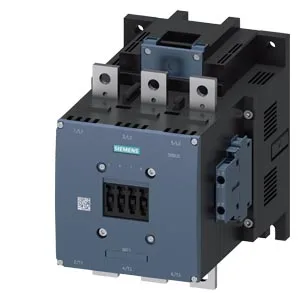
What the S12 frame and coil voltage tell you about fit
The 3RT1075-6AS36: This is a SIRIUS S12-frame power contactor — the largest frame in the SIRIUS contactor family, sized for high-current switching up to the AC-1 and AC-3 duty limits the spec table carries. The 500-550 V AC coil means it pulls in on a nominal 500 V or 550 V control supply; if your panel runs a 480 V control transformer, the coil sees ~10% undervoltage and may not hold in during dips. Stick with the listed voltage range. The coil termination is screw-type terminals — not the push-in or spring-cage variants available on other SIRIUS sizes. That means you're reaching for a screwdriver at termination, not a ferrule and a push. Fine for a fixed install; slower for a panel where every terminal counts against the build clock.
Wiring the main poles and auxiliaries
Auxiliary wiring: solid or stranded from 0.5 to 4 mm², with dual-entry capability on the smaller sizes. The auxiliary switch is built in — no add-on module needed for basic NO/NC feedback. Breaking capacity at 24 V is 10 A, dropping to 1 A at 110 V; keep that in mind if you're switching a PLC input with a long cable run where voltage drop eats into the margin.
Switching frequency and duty cycle reality
Rated at 700 operations per hour in AC-1 (resistive load), 500/h in AC-3 (squirrel-cage motor starting), and 130/h in AC-4 (plugging/inching). The AC-4 figure is the one that governs if you're jogging or reversing a load — at 130 ops/h the contactor is spending most of its time making and breaking locked-rotor current, which wears the arc chutes and contacts faster than a simple start/run cycle. Arcing time is 10-15 ms, dropout time 60-100 ms for both AC and DC. That dropout delay is long enough that a downstream safety relay or PLC input filter needs to account for it — don't expect instantaneous break if the coil loses power mid-cycle.
Mounting clearances and environmental limits
Mounting position: vertical surface, rotatable ±90°, tiltable ±22.5° front-to-back. Clearances: 10 mm up/down/side, 20 mm forward. That forward clearance is the one that catches people — the arc chutes project forward, and if you panel-mount against a door or another device at 15 mm, you're in the arc flash zone. Give it the full 20.
Sourcing and lifecycle for the BOM line
Mechanical life is 10 million operations typical — that's the contactor structure, not the contacts. Electrical life depends on the switching duty (AC-1 vs AC-4) and load current; the 10M figure means the armature and spring assembly outlast several contact tip changes if you're running a heavy-duty cycle.