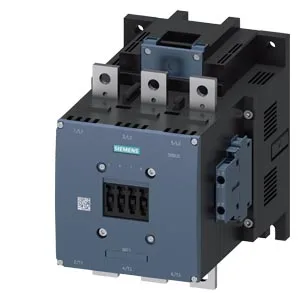
It's a current-production part, so it's still a standard BOM line item, not a scavenger hunt. The main power circuit accepts stranded conductors from 70 up to 240 mm², which is the range you'd expect for feeding a large motor or a distribution bus through the contactor. The auxiliary contact block handles 10 A at 24 V rated value, 2 A at 48 V or 60 V, and 1 A at 110 V — enough for a PLC input or a status lamp, but not for driving another contactor coil directly without checking the inrush. Switching frequency varies by duty class: up to 700 operations per hour at AC-1 (resistive), 500 at AC-3 (squirrel-cage motor starting), and 130 at AC-4 (plugging/inching).
Mounts via screw fixing — four 11 mm holes on a standard pattern for the S12 frame. Depth is 225 mm, so check your enclosure depth before committing; that's deeper than a typical S0 or S3 contactor. Width is 160 mm, height 214 mm. That covers most panel layouts, but if you're stacking multiple contactors side-by-side, the 10 mm side clearance is the minimum to maintain for heat dissipation.
Control wiring and coil
The magnet coil uses screw-type terminals. That's standard for control wiring — 1.5 mm² for signal, 2.5 mm² for coil feeds. That's fast enough for most safety circuits but not instantaneous — if you need a faster break, you'd add a forced-guided contactor or a safety relay.