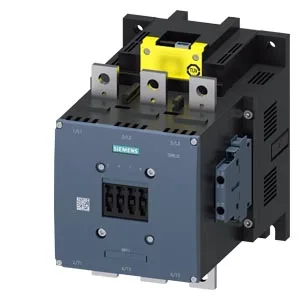
It carries a rated coil voltage of 200 to 277 V AC/DC, so it's a straight fit for common 240 V control circuits — no transformer needed on a 230/240 V supply. The coil terminals are screw-type, and the main power terminals accept stranded cable from 70 mm² up to 240 mm², which tells you this is sized for high-current feeders, not small aux circuits.
The MTBF of 75 a is the mean time between failures — not a warranty, but a reliability benchmark. For a contactor this size, that figure says the coil and main contacts are designed for long service in a clean, well-ventilated enclosure.
This contactor mounts with screw fixing — not DIN-rail snap-on, so budget for a backplate or mounting rail with tapped holes. That's tight for a part that's 214 mm tall, 160 mm wide, and 225 mm deep — make sure your enclosure depth clears the 225 mm plus wiring space for 240 mm² cables.
Coil and auxiliary details
The coil's rated value at 24 V is 10 A, at 48 V it's 2 A, and at 60 V it's 2 A — these are the switching currents for the auxiliary contacts, not the main power path. The main power switching is rated for AC-1, AC-2, AC-3, and AC-4 duty cycles up to 200 operations per hour, with AC-4 (the toughest — plugging and inching) limited to 130 ops/h. That's real-world: a motor starter doing frequent reversals needs the lower AC-4 rate.