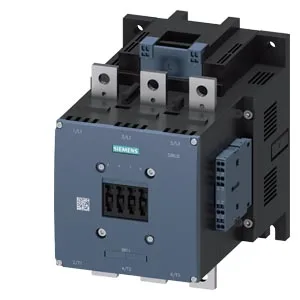
The coil pulls in at 23 to 26 VDC rated value, and the contactor mounts on a vertical surface with screw fixing — rotatable ±90° or tiltable ±22.5° front-to-back for tight enclosure layouts.
The auxiliary contact block is rated 10 A at 24 V, dropping to 2 A at 48 V and 60 V, and 1 A at 110 V. That derating curve tells you the contact set is sized for low-voltage DC switching in PLC or relay logic circuits — not for direct motor-circuit breaking. The main power path uses spring-type terminals on the coil and accepts stranded conductors from 70 to 240 mm² on the power side, with solid or stranded auxiliary wiring from 0.25 to 2.5 mm². That range covers most panel-building practices: power cables land on the larger terminals, control wiring on the spring-cage auxiliaries.
Switching frequency and thermal limits
Maximum switching rates are 500 operations per hour in AC-1 resistive duty, 420 in AC-3 motor duty, and 130 in AC-4 plugging/reversing duty. The AC-3e rating matches the AC-3 figure at 420 ops/h. Those numbers govern the contactor's thermal endurance in repetitive cycling — exceed them and the arc energy builds faster than the steel can sink it.