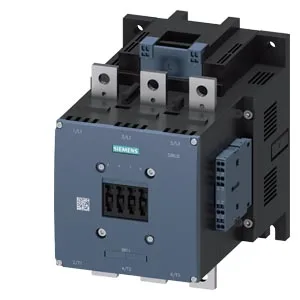
The coil connection uses spring-type terminals, while the main power circuit accepts stranded conductors from 70 to 240 mm². A built-in auxiliary switch is included, rated 10 A at 24 V, 2 A at 48 V or 60 V, and 1 A at 110 V — enough for signaling back to a PLC input or a status lamp without an add-on block.
Mounting is by screw fixing through a single 11 mm hole — not DIN-rail snap-on, so plan for a drilled backplate or mounting rail adapter. Dimensions are 214 mm high, 160 mm wide, 225 mm deep. Minimum clearances: 10 mm upward, 20 mm forward, 10 mm downward, 10 mm to the side. These are the air and creepage distances for heat dissipation and arc quenching — respect them in the layout. The contactor is rated for use in a standard ventilated enclosure; no forced cooling is required at the lower end of the load cycle.
Switching frequency varies by duty class: AC-1 (resistive) allows up to 500 operations per hour, AC-3 (squirrel-cage motor starting) allows 420 per hour, AC-4 (plugging/inching) drops to 130 per hour. AC-2 (slip-ring motor) is rated at 170 per hour. These are maximums — derate for higher ambient or heavier loads. The coil pick-up and drop-out range is 0.8 to 1.1 times rated voltage, so the coil holds in reliably down to 460 V on a 575 V system. Power factor at 50 Hz and 60 Hz is 0.9 — typical for a large AC contactor coil, meaning the inrush current is moderate.
The closest functional peer is the 3RT1076-2NP36, which shares the same S12 frame size and screw-fixing mount but uses a different coil voltage. Verify coil compatibility before substituting — the 2AT36 is a 575-600 V AC coil variant, while the 2NP36 is a different coil voltage. The physical footprint and main circuit ratings are identical, so a panel swap is possible if the control voltage matches.