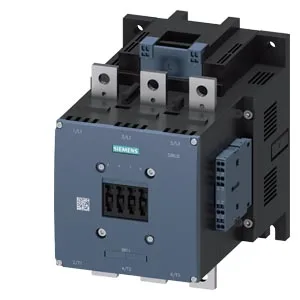
SIRIUS S12 Power Contactor — 3RT1076-2AV36
Rated coil voltage is 380-420 VAC, with a pick-up threshold of 0.8 x rated value and a drop-out at 1.1 x rated value — meaning it holds in during brownouts down to about 304 VAC and releases cleanly above 462 VAC. Opening time is 60-100 ms on both AC and DC supplies, with an arcing time of 10-15 ms, so the contactor clears faults fast enough for most motor branch circuits without nuisance tripping upstream. The main power terminals accept stranded conductors from 70 to 240 mm² — that's a 4/0 AWG to 500 kcmil range — so it handles the heavy feed for a large motor or a resistive bank. The coil terminals use spring-type cages accepting 2x (0.25-2.5 mm²) solid or stranded, which speeds wiring on the control side.
Duty Ratings and Switching Frequency
This contactor is rated for multiple duty classes, and the switching frequency tells you which application it fits. At AC-1 (resistive loads) it manages up to 500 operations per hour; at AC-3 (squirrel-cage motors, starting and disconnecting running) it's 420 ops/h; at AC-4 (plugging, inching, reversing) it drops to 130 ops/h. The AC-3e rating (enhanced AC-3 for electronic motor protection) also sits at 420 ops/h. Auxiliary contacts are built in, rated at 10 A at 24 V, 2 A at 48 V, 2 A at 60 V, and 1 A at 110 V — these cover typical PLC input sensing or relay coil control without an add-on block. Mechanical life is quoted at 10 million operations typical, so it outlasts most panel refreshes.
Physical footprint: 225 mm deep, 214 mm high, 160 mm wide. Mounting clearance: 10 mm upwards, 10 mm downwards, 20 mm forwards, 10 mm at the sides — so it needs about 245 mm of enclosure depth and 234 mm of height. The single 11 mm mounting hole suggests a bolt-through pattern rather than a DIN-rail clip; plan for screw-fixing hardware. Operating temperature range is -25 to +60 °C, storage from -55 to +80 °C — fine for unheated plant rooms but check derating above 40 °C if you're pushing the switching frequency limits. Power factor at 50/60 Hz is 0.9, typical for a large AC coil.