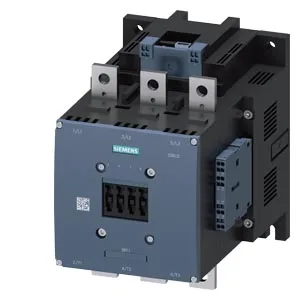
It's a current-production part, so it's a standard line item when you're filling a BOM for a new panel or a critical spare for an existing SIRIUS-based installation. That spring-clamp on the coil saves a bit of wire-prep time during panel wiring — no screw torquing to check on that circuit. Mounting is via screw fixing with a single 11 mm hole, and the part allows a fair bit of orientation flexibility: it's rotatable +/-90° on a vertical surface and tiltable +/-22.5° front-to-back. That helps when you're shoehorning it into a tight enclosure layout.
The main power terminals accept stranded cable from 70 mm² up to 240 mm², so this is sized for heavier feeder or motor circuits — not a small auxiliary relay. The auxiliary circuit terminals take 2x (0.25 to 2.5 mm²) solid or stranded, which is the standard range for control wiring. It carries an auxiliary switch block, with rated values at 24 VDC of 10 A, dropping to 2 A at 48 V and 60 VDC, and 1 A at 110 VDC. That's the contact rating for your PLC inputs or pilot lights — make sure your load doesn't exceed those DC break points, especially at the higher voltages. Mechanical life is listed at a typical 10 million operations, which is solid for a contactor this size.
Physical footprint: 214 mm high, 160 mm wide, 225 mm deep. That depth is the dimension to watch when you're sizing the enclosure depth — 225 mm means a standard 300 mm deep panel is fine, but a shallow 200 mm backbox won't clear it. Plan your DIN-rail or backplate layout with those gaps in mind for heat dissipation and wiring access. That -25 °C lower end is fine for most indoor panel environments, but if this lives in an unheated warehouse or a cold-climate outdoor cabinet, verify the ambient stays above that floor.