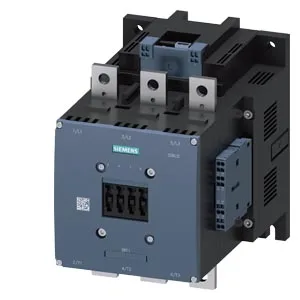
It's a current-production part, so no lifecycle surprises when you go to fill a BOM line — this is the active catalog item, not an NRND or phase-out code. The coil is rated for 96-127 V AC/DC, which covers common control voltages in European and Asian panels. The magnet coil termination uses spring-type terminals — no screw torque to check, just strip and push. That's a time-saver on the panel build and a reliability win in high-vibration environments. That flexibility matters when you're fitting it into a crowded enclosure and the gland plate dictates the orientation.
Sizing and fit — S12 frame
The S12 frame is the physical envelope: 214 mm high, 160 mm wide, 225 mm deep. That depth is the dimension you need to check against your enclosure depth — at 225 mm it's not a shallow-panel part. The main power terminals accept stranded wire from 70 mm² up to 240 mm², so it's sized for heavy motor feeders, not control wiring. Auxiliary and coil terminals take 2x (0.25-2.5 mm²) solid or stranded, spring-cage style. That's a separate wire range from the main poles — don't run the main motor leads through the aux terminals.
Switching duty and ratings
The contactor is rated for different switching frequencies depending on duty class: 500 operations/hour in AC-1 (resistive), 420 in AC-3 (standard motor starting), and 130 in AC-4 (plugging/inching). AC-3e follows the same 420 cycles/hour as AC-3. If your application involves frequent reversing or jogging, the AC-4 limit of 130 ops/hour is the binding constraint — don't spec it against the AC-3 number. The auxiliary switch is present and rated at 10 A at 24 V, 2 A at 48 V and 60 V, and 1 A at 110 V. These are the contact ratings for the aux block — useful for interlocking or status feedback to a PLC input. Arcing time is 10-15 ms, and the contactor picks up in 80-100 ms on both AC and DC. Drop-out and pick-up times are symmetrical, which simplifies timing coordination in sequential start schemes.
Environmental and clearance
That's the minimum free air space for heat dissipation and arc flash containment. In a dense panel, check that the forward clearance of 20 mm isn't eaten by a door-mounted HMI or terminal block.