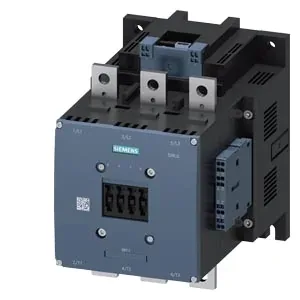
What this SIRIUS S12 contactor is
It is a current-production part, actively manufactured.
The magnet coil is rated for 200–277 V AC and terminates on spring-type terminals — no screw torque to verify, but the stripped length and ferrule size matter for a reliable hold. Coil pick-up and drop-out times run 80–100 ms on AC and DC alike, so don't expect a fast-acting contactor for precise load shedding; this is a general-purpose switching device.
Duty-cycle and switching frequency
Switching frequency varies sharply by duty class: AC-1 (resistive) allows 500 operations per hour, AC-3 (squirrel-cage motor start/run) drops to 420 ops/h, AC-2 (slip-ring motor) to 170 ops/h, and AC-4 (plugging/inching) to 130 ops/h. For a motor-switching application, the AC-3e rating at 420 ops/h is the one that governs real throughput — exceeding it accelerates contact wear.
Auxiliary contacts and environmental limits
An auxiliary switch is built in, rated 10 A at 24 V, 2 A at 48 V and 60 V, 1 A at 110 V — sufficient for signalling to a PLC input or a pilot light, but watch the voltage derating curve if you're switching DC inductive loads.