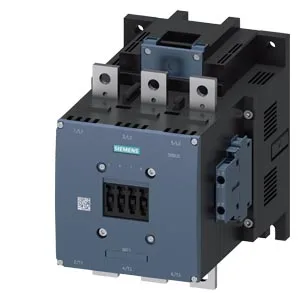
It's rated for a 23-26 V coil with an initial pickup of 0.8 times rated, and the screw-type terminals handle stranded cable from 70 up to 240 mm² on the power side — that's serious wire for a serious contactor, sized for big motors or heavy feeder duty.
This contactor measures 225 mm deep by 160 mm wide by 214 mm tall, and it's a screw-fixing mount on a vertical surface — not a DIN-rail snap-on. Keep the arcing clearance in mind: you need 10 mm upwards, 20 mm forwards, 10 mm downwards, and 10 mm at the side to let the arc quench safely — the listed arcing time runs 10 to 15 ms. Opening delay on both AC and DC coils is 60 to 100 ms, so it's not a fast-switching device; plan your control sequence accordingly. The auxiliary switch is built in, rated at 10 A at 24 V, 2 A at 48 V, 2 A at 60 V, and 1 A at 110 V. If you're switching a PLC output or a small relay coil, those numbers tell you the contact can handle it, but don't push it past those voltage-specific limits.
Duty cycles and mechanical life
The mechanical life of this contactor is typical at 10 million operations — that's a lot of cycles. The maximum switching rates per hour vary by duty: AC-1 (resistive) allows 500 cycles/h, AC-3 (motor starting) allows 420 cycles/h, AC-3e (the enhanced motor rating) also 420 cycles/h, AC-2 (slip-ring motor) drops to 170 cycles/h, and AC-4 (plugging/inching) is down to 130 cycles/h. If you're running a conveyor that starts and stops every minute, you'll stay within the AC-3 limit; if you're doing reversing or jogging, you need to respect the AC-4 ceiling.