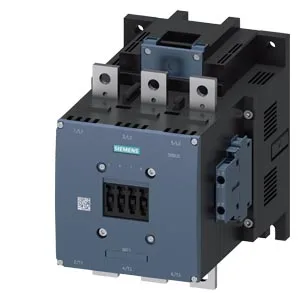
It carries a built-in auxiliary switch and is rated for 10,000,000 mechanical cycles — no up-tower swaps on a pitch-drive contactor if you spec this one right. The coil pulls 10 A at 24 V rated value and drops to 2 A at 48 V and 60 V, so the control transformer sizing is straightforward for a 42-48 VAC/DC loop.
Switching rates vary by duty category: 500 cycles/hour in AC-1 (resistive), 420 in AC-3 and AC-3e (standard motor start/run), 170 in AC-2 (slip-ring motor), and 130 in AC-4 (plugging/inching). For a conveyor motor running continuous start/stop under AC-3, the 420 cycles/hour limit governs the pick-and-place cadence. Arcing time is 10-15 ms with operate delays of 60-100 ms on both AC and DC — consistent with a standard electromechanical contactor that doesn't need a soft-start gate on the coil drive.
Fastened via screw fixing with an 11 mm mounting hole. The contactor can be mounted on a vertical surface and rotated ±90° or tilted ±22.5° forward/back — useful when the gland plate is tight and you need to angle the contactor to clear a busbar. Main power terminals accept stranded wire from 70 to 240 mm² — sized for the S12 frame's typical current range. The auxiliary and coil terminals handle solid or stranded 0.5-1.5 mm² (two conductors), 0.75-2.5 mm² (two), or up to 4 mm² (two). Keep those minimums when routing cables or stacking contactors side-by-side on a DIN rail adapter plate.
This is not an NRND or obsolete part, so the BOM line can be frozen with confidence.