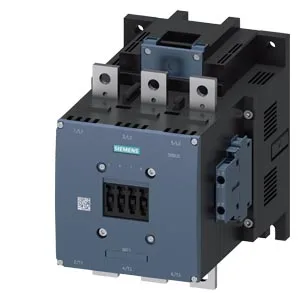
The coil is rated for 200-220 V AC, with a pickup threshold of 0.8 x rated value and a dropout factor of 0.55 x rated value, so it holds in reliably down to about 110 V and drops out around 121 V. Main power wiring accepts stranded conductors from 70 to 240 mm² — that's the business end for motor feeders up to the contactor's rated current class. The coil terminals are screw-type, matching the main power connection style.
Mounting is by screw fixing through a single 11 mm hole. The contactor can be mounted on a vertical surface and rotated ±90°, or tilted ±22.5° front-to-back, giving flexibility in tight enclosures. These are the air gaps needed for arc containment and heat dissipation — don't crowd it. The storage limit is for handling and warehousing, not running.
Switching performance and duty ratings
Switching frequency varies by duty class: AC-1 (resistive) allows up to 500 operations per hour, AC-3 (motor starting, running) allows 420/h, AC-4 (plugging, inching) allows 130/h. The AC-3e rating also sits at 420/h. These are maximums — real-world derating depends on load current and ambient temperature. Power factor at 50 and 60 Hz is 0.9.
The built-in auxiliary switch is rated for 10 A at 24 V, 2 A at 48 V, 2 A at 60 V, and 1 A at 110 V. These are the contact ratings for the aux circuit — match your PLC input or relay coil draw accordingly.