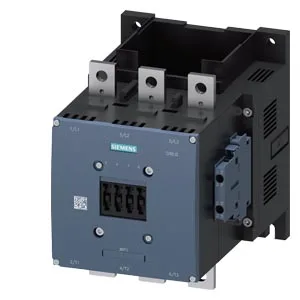
Power cable termination accepts stranded conductors from 70 mm² up to 240 mm², so this contactor lands in the heavy end of the SIRIUS range — think large pumps, compressors, or conveyor drives drawing several hundred amps. The auxiliary contact block is screw-type, and the contactor ships with one auxiliary switch built in. Auxiliary contact ratings cover 24 VDC at 10 A down to 440 VAC at 1.4 A — enough for most PLC input or relay interlock circuits.
Clearance and integration
That 20 mm forward clearance is the one that catches panel builders — the arcing chamber needs room, and the depth of 225 mm already pushes into the enclosure. Plan your backpanel depth accordingly. Mounting uses a single 11 mm hole — screw fixing, not DIN rail. The Size S12 frame is too large for a snap-on rail; expect to bolt it directly to the mounting plate. Auxiliary terminal wiring accepts 2x (0.5–1.5 mm²) solid or 2x (0.75–2.5 mm²) stranded, max 2x (0.75–4 mm²). Standard spring-cage or screw-clamp range for control wiring.
Switching performance and life
Switching frequency varies by duty: 500 cycles/hour in AC-1 (resistive), 420 in AC-3 or AC-3e (standard motor starting), 170 in AC-2 (slip-ring motor), and 130 in AC-4 (plugging/inching). For a high-cycle conveyor or frequent reversing application, the AC-4 limit of 130 ops/hour is the binding constraint. Operating times: 60–100 ms at both AC and DC coil supply. That puts the total break time around 70–115 ms — fast enough for most motor protection coordination schemes, but verify selectivity with upstream breaker curves if the fault current is high.
Environmental limits
The storage limit is wider because the contactor is not dissipating heat; the operating limit governs the panel ambient. If your enclosure hits 60 °C internally, this contactor still switches — but derate the continuous current per Siemens' thermal curve.