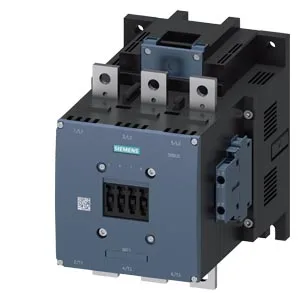
The coil is rated for 200-277 V AC, with a pickup operating time of 80-100 ms on both AC and DC supplies. The arcing time sits at 10-15 ms. Minimum operating factor is 0.8 at 50 Hz and 0.8-1.1 at 60 Hz, so it holds in during brownout conditions down to 80% of rated voltage. Main power terminals accept stranded conductors from 70 to 240 mm² — that's the range you'd expect for a contactor this size, handling supply feeds up to several hundred amps. Auxiliary control wiring uses screw-type terminals accepting solid wire: 2x (0.5-1.5 mm²), 2x (0.75-2.5 mm²), or max 2x (0.75-4 mm²). The auxiliary switch is present and rated at 10 A at 24 V, 2 A at 48 V, 2 A at 60 V, and 1 A at 110 V — typical for signaling back to a PLC input or a status lamp.
Physical footprint: 214 mm high, 180 mm wide, 225 mm deep. That depth is the dimension you need to check against your enclosure depth — at 225 mm, it's a deep unit, so plan for cable bending radius behind it. Mounting uses one hole of 11 mm diameter. Protection degree is IP00 on the terminals and IP20 on the front with the cover or box terminal installed. Maximum switching frequencies: 500 operations/hour in AC-1 (resistive), 170 in AC-2 (slip-ring motors), 420 in AC-3 (squirrel-cage motors), and 130 in AC-4 (plugging/inching).