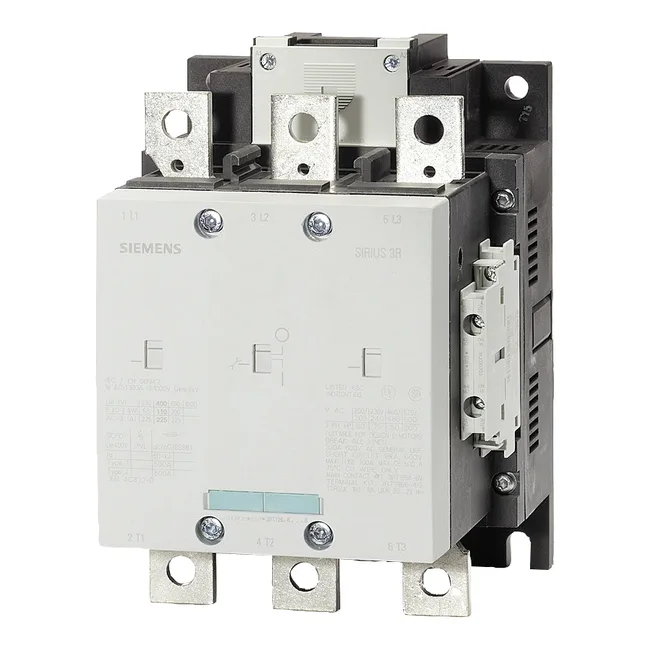
The contactor measures 210 mm high, 145 mm wide, and 206 mm deep, and mounts via screw fixing with two 11 mm diameter holes.
The coil is rated 42-48 V — a common control voltage in many industrial installations, using screw-type terminals for secure wiring. The contactor includes an auxiliary switch, with contact ratings of 10 A at 24 V, 2 A at 48 V, 2 A at 60 V, and 1 A at 110 V — enough for signaling back to a PLC or indicating contactor status. Switching frequency varies by duty class: up to 800 operations per hour in AC-1 (resistive), 750 in AC-3 (standard motor starting), and 250 in AC-4 (plugging/inching) — the AC-3 figure is the one that governs most conveyor and pump applications. The main power circuit accepts stranded conductors from 70 to 240 mm², while auxiliary circuits accept 2x (0.5 to 1.5 mm²) solid or 2x (0.75 to 2.5 mm²) stranded, up to 4 mm² maximum.
Because it is a vacuum contactor rather than an air-break design, it offers longer contact life in high-cycling applications and is preferred in environments where contact erosion from arcing must be minimized.