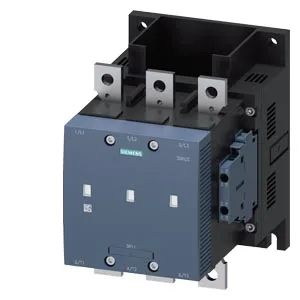
That matters when you're retrofitting into a panel with limited clearance for arc flash containment. Auxiliary contacts are included with a 24 V rated value of 10 A, dropping to 0.3 A at 220 V and 0.9 A at 125 V. These are the control-circuit ratings you use for PLC feedback or interlock loops — don't load them above the curve for the voltage you're running. The wider storage limit governs handling and shipping, not running — if the panel ambient stays under 60 °C, no derating needed.
Fastening is screw fixing with a single 11 mm hole. Dimensions are 210 mm height, 145 mm width, 206 mm depth — that depth includes the arc chamber and terminals, so allow clearance for the main power cables (stranded 70 to 240 mm²,). That gives you some layout flexibility in a crowded enclosure, but the 10 mm upwards, 20 mm forwards, 10 mm sideways, and 10 mm downwards clearances are the minimums for arc venting and cable bending.
Mechanical and switching endurance
Typical mechanical life is 10,000,000 operations — that's the contactor body, not the vacuum bottle. For switching duty, AC-1 (resistive) allows 800 cycles/hour, AC-3 (motor starting) allows 750 cycles/hour, and AC-4 (plugging/inching) drops to 250 cycles/hour. AC-3e (motor with electronic overload) also allows 750 cycles/hour. Pick your operating class based on the load profile. That's fast enough for most motor protection schemes but verify coordination with your upstream breaker if you're in a selective coordination study.